
Optic Mounting Hardware: Screw Lengths, Thread Pitches & Extractor-Channel Bottom-Out
The short answer: Most loose, sheared, or malfunctioning pistol red dots are caused by right thread pitch, wrong screw length. Even a 1.5 mm over-length screw will bottom out on an adapter plate floor (giving a false 15 in-lbs torque click) or crush the right-side extractor depressor plunger—while a screw 2 threads too short rips out under 3,000 G slide acceleration.
Interactive Optic Screw Protrusion & Clearance Calculator
Select your slide platform and enter your screw's overall length (OAL) in millimeters (or choose from the presets) to verify thread engagement and extractor-channel clearance.
Platform Clearance Analysis
Loading platform clearance limits...
1. Thread Pitch vs. Diameter: Why Screws Strip in Two Turns
Every optics-ready pistol on the market uses one of four fastener standards. Because optic screws are short (7 mm to 12 mm) and hardened, grabbing the wrong bag from your parts bin will destroy the soft stainless steel slide threads before you feel resistance.
| Thread Spec | Major Diameter | Pitch / TPI | Where You Encounter It | Danger Trap (Do Not Mix) |
|---|---|---|---|---|
| 6-32 UNC | 0.138″ (3.51 mm) | 32 TPI (0.79 mm pitch) | Trijicon RMR/SRO, Holosun 507C/508T, Glock MOS plates, Springfield Echelon VIS, S&W C.O.R.E., Walther PDP 2.0 | Looks identical to M3.5 × 0.6! A 6-32 screw will thread 1.5 turns into an M3.5 hole and gall the threads permanently. |
| M4 × 0.7 | 0.157″ (4.00 mm) | 0.70 mm metric pitch | Glock 43X/48 MOS, SIG P365-XMACRO/XL (new), SIG P320 DPP/R1P, Springfield Hellcat/Pro, Canik METE | Slightly wider than 6-32 UNC; forcing an M4 screw into a 6-32 plate strips the plate threads immediately. |
| M3.5 × 0.6 | 0.138″ (3.50 mm) | 0.60 mm metric pitch | Select aftermarket adapter plates (C&H Precision, Forward Controls Design) & European RMSc cuts | Never substitute 6-32 screws into M3.5 plate holes—always use the fasteners supplied by the plate maker. |
| M3 × 0.5 | 0.118″ (3.00 mm) | 0.50 mm metric pitch | Early SIG P365-XL slides (bottom-mounted cover plate) & Glock MOS adapter plate-to-slide screws | Small cross-section shears easily above 12–15 in-lbs; always use a calibrated inch-pound torque driver. |
2. Three Ways "Right Thread, Wrong Length" Destroys Reliability
Even when you match the exact thread pitch, three mechanical failure modes happen whenever screw length is off by even 1 to 2 millimeters:
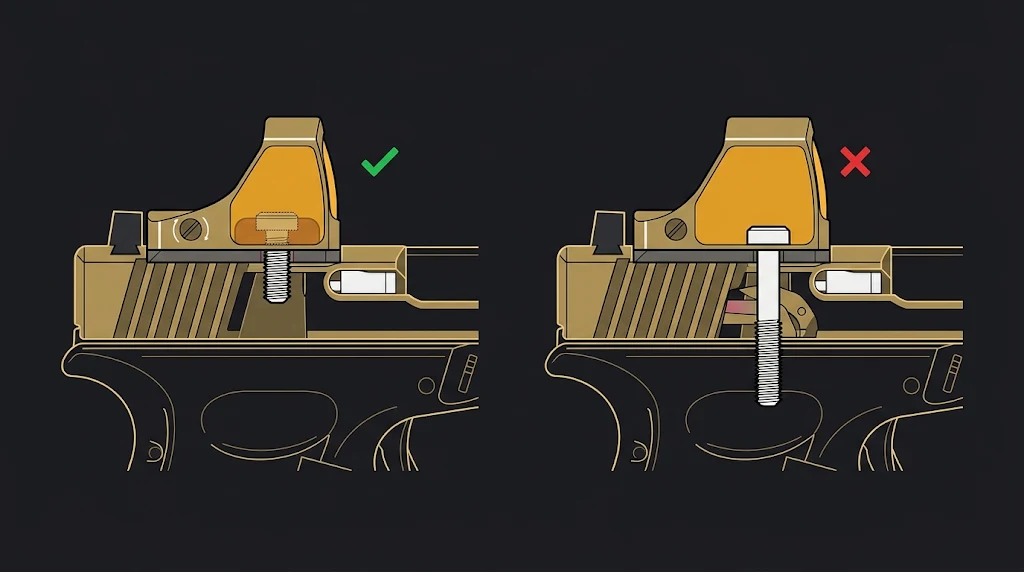
Slide Cross-Section: Right-Side Extractor Plunger Trap
On most striker-fired pistols, the extractor depressor plunger assembly sits directly below the right-hand optic screw hole. An over-long right screw pins the plunger spring solid—causing failures to extract, erratic brass ejection, or a slide that will not strip down cleanly.
Adapter Plate Jacking vs. Proper Threadlocker Cure
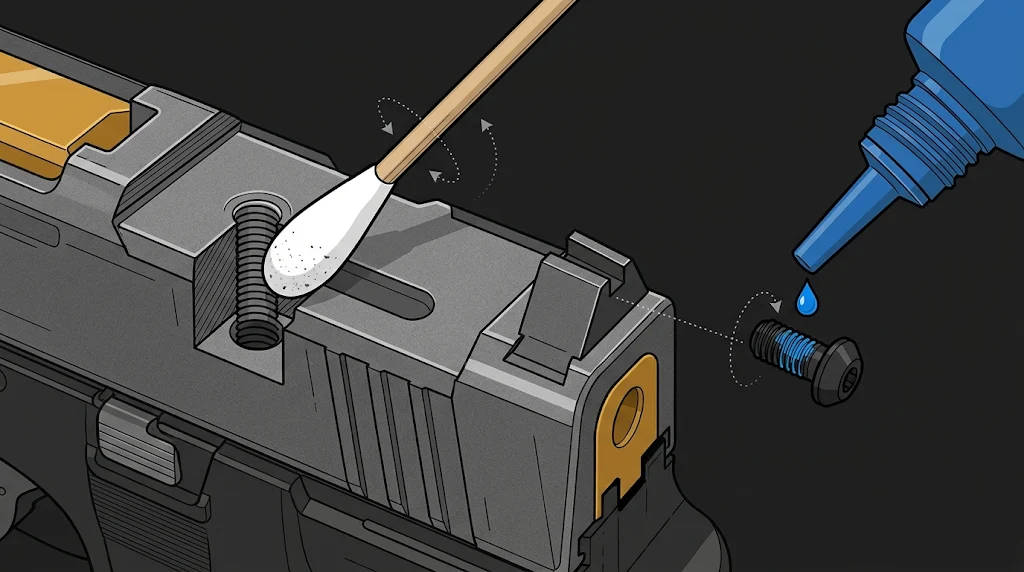
Adapter Plate Jacking: On Glock MOS, S&W C.O.R.E., and Walther PDP plates, if an optic screw is 1 mm longer than the plate thickness, the screw tip hits the slide roof and pushes the plate upward. Your torque wrench clicks at 15 in-lbs, but the optic isn't clamped—it rattles loose within 50 rounds.
Recoil Lug Alignment Before Fastening
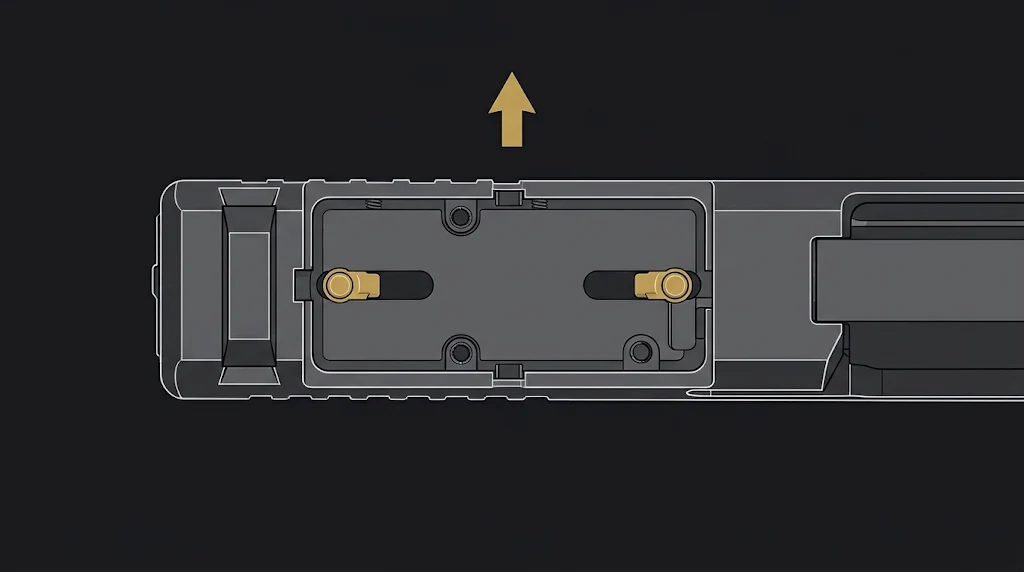
Screws Clamp Downward; Recoil Lugs Absorb Shear: Never rely on screw shafts to stop fore-and-aft slide recoil. Confirm your optic sits dead-flat over the slide or plate recoil bosses (such as Springfield's VIS pins or Glock MOS lugs) with zero daylight underneath before tightening.
Calibrated Torque & Witness Marking
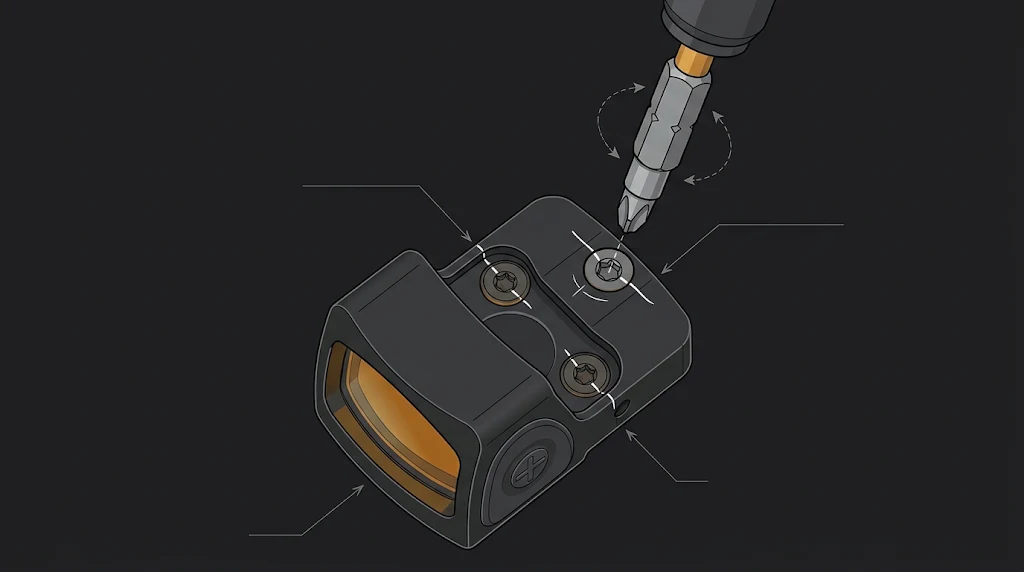
Visual Zero Verification: After torquing to 15 in-lbs (never foot-pounds), draw a fine paint-pen witness line from the screw slot onto the optic housing. A 1-second glance before every range trip or carry shift immediately reveals if a fastener has backed out even 5 degrees.
Minimum Thread Engagement Rule (The 3-Turn Floor)
Going too short is just as dangerous as going too long. A steel screw in a steel or aluminum slide needs at least 2.5 mm to 3.0 mm of engaged thread (roughly 3.5 to 4 full turns after the threads catch) to resist slide deceleration. If a screw catches for only 1.5 turns before feeling tight, stop—the thread engagement is too shallow and will strip under recoil.
3. Pistol Optic Screw & Torque Quick-Reference Matrix
Use this bench table for the most common factory optics-ready platforms, or look up any of 50 pistols and 12 optics in our Optic Footprint & Screw Matcher.
| Pistol Platform | Mount Type | Thread Pitch | Safe Screw Length | Torque & Critical Clearance Note |
|---|---|---|---|---|
| Springfield Echelon 4.5F / 4.0C | Direct VIS Pins | 6-32 UNC | 0.280″–0.310″ (7.1–7.9 mm) | 15 in-lbs (Loctite 243). Max protrusion below optic base ≤ 0.110″ (2.8 mm) to clear right-side extractor channel. |
| Glock 19 / 17 / 45 Gen 5 MOS | MOS Plate #02 | 6-32 UNC | 0.250″–0.300″ (6.4–7.6 mm) | 15 in-lbs optic / 13–15 in-lbs plate. Screw must sit flush or recessed under bottom of MOS plate. |
| Glock 43X / 48 MOS | Direct RMSc / K | M4 × 0.7 | 8.0 mm–9.5 mm | 15 in-lbs. Right screw > 9.5 mm contacts the extractor depressor plunger; file or swap right screw shorter. |
| SIG Sauer P365-XL / XMACRO | Direct K / RMSc | M4 × 0.7 | 8.0 mm–9.5 mm | 12–15 in-lbs. Older rear-sight-plate P365-XL slides used bottom-up M3 screws; verify top-threaded holes first. |
| Springfield Hellcat / Pro OSP | Direct RMSc / Plate | M4 × 0.7 | 8.0 mm–9.5 mm | 15 in-lbs. Holosun K optics require thin adapter plate or rear lug trimming; verify right screw clearance. |
| Canik METE SFT / SFX / MC9 | Direct K / RMSc | M4 × 0.7 | 7.5 mm–8.5 mm | 12–15 in-lbs. Shallow blind slide bores; use Canik's included short screws instead of Holosun's long set. |
| S&W M&P9 M2.0 Optics Ready | C.O.R.E. Plate | 6-32 UNC | 0.250″–0.300″ (6.4–7.6 mm) | 15 in-lbs. Confirm screws do not protrude beneath the adapter plate deck before final torque. |
| Walther PDP Compact / Full (2.0) | PDP 2.0 Plate | 6-32 UNC | 0.250″–0.300″ (6.4–7.6 mm) | 15 in-lbs. Confirm slide has the Generation 2.0 cut (with recoil pockets) before ordering plates. |
4. 5-Step Armorer Installation & Extractor Verification Protocol
Measure Protrusion Off the Slide
Drop each screw through the optic (and plate, if used) while holding it in your hand. Measure the exposed thread below the bottom face with calipers and verify it stays under your slide's limit.
Flush Factory Oil From Blind Holes
Factory slides ship with preservative oil inside the optic holes. Clean both the slide threads and screw threads with 91%+ isopropyl alcohol or non-chlorinated brake cleaner on a cotton swab and let dry.
Dry-Torque & Test Extractor Movement
Before applying threadlocker, snug both screws down and depress the extractor claw / check the extractor depressor plunger. If the plunger feels gritty or binds, the right screw is 1–2 mm too long.
Apply Loctite 243 & Torque to 15 in-lbs
Apply a small dab of oil-tolerant Loctite 243 (not red 271) to the bottom 3 threads only—keep liquid out of the bottom of blind holes where hydraulic pressure can crack thin slide decks. Alternate screws in stages up to 15 in-lbs.
24-Hour Cure + Paint Witness Lines
Allow 24 hours for full anaerobic threadlocker cure before live fire, then mark each screw head to the optic housing with a fine oil-based paint pen.
Frequently Asked Questions
Why can the right-side optic screw cause failures to extract even when torqued to 15 in-lbs?
On striker-fired pistols such as Glock, SIG P365, Springfield Echelon, Hellcat, and S&W M&P, the extractor depressor plunger assembly runs longitudinally inside the right side of the slide directly beneath the right optic screw hole. If the right screw protrudes even 1 mm too deep, it pinches the extractor plunger spring and causes erratic ejection or stovepipes.
What happens if you confuse M3.5, M4 × 0.7, and 6-32 UNC optic screws?
6-32 UNC (0.138″ / 3.51 mm major diameter, 32 TPI) and M3.5 × 0.6 (3.50 mm diameter) look nearly identical to the naked eye and may start turning by hand, but forcing a 6-32 screw into a metric hole—or an M4 × 0.7 screw into a 6-32 hole—shears the internal slide threads within two turns.
Why do optic screws loosen on a Glock MOS plate even with blue Loctite?
If the optic screws are slightly longer than the thickness of the MOS adapter plate, the screw tips hit the steel slide floor before the screw heads clamp the optic body. Your torque wrench clicks at 15 in-lbs against the slide floor while leaving the optic free to vibrate and shear the screws under recoil.
Can I file down an optic screw that is 1.5 mm too long?
Yes, provided you thread a matching nut onto the screw first, file the tip flat on a fine stone or file, lightly bevel the leading thread edge, and back the nut off to chase and clean the starting threads before installing.